Other products
Advantix (25 - 40 kg)
ATC code
Species
Dogs
Indications
For dogs with, or at risk from mixed infestations by fleas, biting lice, ticks, sand flies, mosquitos and stable flies. The veterinary medicinal product is only indicated when use against parasites targeted by each of the combined active substances is indicated at the same time.
For the treatment and prevention of flea (Ctenocephalides canis, Ctenocephalides felis) infestation.
Fleas on dogs are killed within one day following treatment. One treatment prevents further flea infestation for four weeks. The veterinary medicinal product can be used as part of a treatment strategy for flea allergy dermatitis (FAD).
Treatment of biting lice (Trichodectes canis).
The veterinary medicinal product has persistent acaricidal and repellent efficacy against tick infestations (Rhipicephalus sanguineus and Ixodes ricinus for four weeks, and Dermacentor reticulatus for three weeks).
Reduction of the risk of transmission of the vector-borne pathogen Ehrlichia canis, thereby reducing the risk of canine ehrlichiosis by acaricidal and repellent activity on the tick vector Rhipicephalus sanguineus. The reduction in risk has been shown to begin from three days following application of the veterinary medicinal product and to persist for four weeks.
Ticks already on the dog may not be killed within two days after treatment and may remain attached and visible. Therefore the removal of ticks already on the dog at the time of treatment is recommended, in order to prevent them from attaching and having a blood meal.
One treatment provides repellent (anti-feeding) activity against sand flies (Phlebotomus papatasi for two weeks and Phlebotomus perniciosus for three weeks), against mosquitoes (Aedes aegypti for two weeks and Culex pipiens for four weeks) and against stable flies (Stomoxys calcitrans) for four weeks.
Reduction of the risk of transmission infection of the vector-borne pathogen Leishmania infantum, thereby reducing the risk of canine leishmaniosis by repellent (anti-feeding) activity on sandflies (vector Phlebotomus papatasi for two weeks and vector Phlebotomus perniciosus for three weeks). The effect is indirect due to the veterinary medicinal product’s activity against the vector.
Dose to be administered and administration route
Spot-on use. For external use only. Apply only to undamaged skin.
The recommended minimum dose is:
10 mg/kg body weight (bw) imidacloprid and 50 mg/kg body weight (bw) permethrin.
Dosing Scheme
|
Dogs (kg bw) |
Trade name |
Volume (ml) |
Imidacloprid (mg/kg body weight) |
Permethrin (mg/kg body weight) |
|
> 25 kg 40 kg |
Advantix 400 mg + 2000 mg |
4.0 ml |
10 - 16 |
50 - 80 |
Underdosing could result in ineffective use and may favour resistance development. To ensure a correct dosage, body weight should be determined as accurately as possible.
Ticks, fleas:
The need and frequency of re-treatment(s) should be based on local epidemiological situation and the animal’s lifestyle.
Biting lice:
In case of biting louse infestation, a further veterinary examination 30 days after treatment is recommended as some animals may require a second treatment.
Sand flies:
To protect a dog over the whole sand fly season, treatment should be compliantly continued throughout.
Method of administration
Remove one pipette from the package. Hold applicator pipette in an upright position, twist and pull cap off. Turn the cap around and place the other end of cap back on pipette. Twist cap to break seal, then remove cap from pipette.
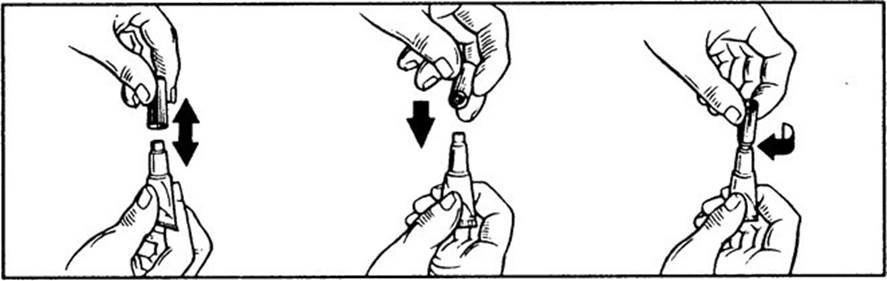
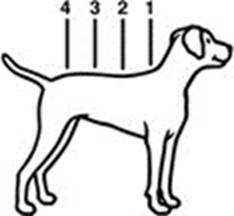
With the dog standing still, the entire contents of the pipette should be applied evenly to four spots on the top of the back from the shoulder to the base of the tail. At each spot, part the hair until the skin is visible. Place the tip of the pipette on the skin and gently squeeze to expel a portion of the solution on the skin. Do not apply an excessive amount of solution at any one spot that could cause some of the solution to run off the side of the dog.
Adverse reactions
Dogs.
|
Uncommon (1 to 10 animals / 1,000 animals treated): |
Application site hair change (e.g. greasy fur), Application site itching Vomiting |
|
Rare (1 to 10 animals / 10,000 animals treated): |
Application site erythema, Application site hair loss, Application site inflammation Diarrhoea |
|
Very rare (<1 animal / 10,000 animals treated, including isolated reports): |
Agitation1,2,4, Restlessness1,2,4, Rolling1,2,4, Whining1,2,4 Hypersalivation1,2,4 Decreased appetite1,2,4, Lethargy1,3 Neurological signs (Abnormal movement and Twitching)1,2,4, Tremor3 Rubbing1,4, Scratching1,4 |
1 Generally self-resolving.
2 In dogs susceptible to permethrin.
3 Following inadvertent oral uptake in dog. There is no known specific antidote; symptomatic treatment recommended.
4 Transient.
Reporting adverse events is important. It allows continuous safety monitoring of a veterinary medicinal product. Reports should be sent, preferably via a veterinarian, to either the marketing authorisation holder or the national competent authority via the national reporting system. See the package leaflet for respective contact details.
Dispensing
POM-V - Prescription Only Medicine – Veterinarian TRUSTED SOURCE
SUMMARY OF PRODUCT CHARACTERISTICS
1. NAME OF THE VETERINARY MEDICINAL PRODUCT
Advantix 400 mg + 2000 mg spot-on solution for dogs (> 25 kg ≤ 40 kg)
2. QUALITATIVE AND QUANTITATIVE COMPOSITION
Each pipette of 4.0 ml contains:
Active substances:
Imidacloprid: 400.0 mg Permethrin (40/60): 2000.0 mg Excipients:
|
Qualitative composition of excipients and other constituents |
Quantitative composition if that information is essential for proper administration of the veterinary medicinal product |
|
Butylhydroxytoluene (E321) |
4.0 mg |
|
Citric acid (E330) |
|
|
N-Methylpyrrolidone |
1936 mg |
|
Triglycerides, medium-chain |
|
Clear yellowish to brownish solution
3. CLINICAL INFORMATION
3.1 Target species
Dogs
3.2 Indications for use for each target species
For dogs with, or at risk from mixed infestations by fleas, biting lice, ticks, sand flies, mosquitos and stable flies. The veterinary medicinal product is only indicated when use against parasites targeted by each of the combined active substances is indicated at the same time.
For the treatment and prevention of flea (Ctenocephalides canis, Ctenocephalides felis) infestation.
Fleas on dogs are killed within one day following treatment. One treatment prevents further flea infestation for four weeks. The veterinary medicinal product can be used as part of a treatment strategy for flea allergy dermatitis (FAD).
Treatment of biting lice (Trichodectes canis).
The veterinary medicinal product has persistent acaricidal and repellent efficacy against tick infestations (Rhipicephalus sanguineus and Ixodes ricinus for four weeks, and Dermacentor reticulatus for three weeks).
Reduction of the risk of transmission of the vector-borne pathogen Ehrlichia canis, thereby reducing the risk of canine ehrlichiosis by acaricidal and repellent activity on the tick vector Rhipicephalus sanguineus. The reduction in risk has been shown to begin from three days following application of the veterinary medicinal product and to persist for four weeks.
Ticks already on the dog may not be killed within two days after treatment and may remain attached and visible. Therefore the removal of ticks already on the dog at the time of treatment is recommended, in order to prevent them from attaching and having a blood meal.
One treatment provides repellent (anti-feeding) activity against sand flies (Phlebotomus papatasi for two weeks and Phlebotomus perniciosus for three weeks), against mosquitoes (Aedes aegypti for two weeks and Culex pipiens for four weeks) and against stable flies (Stomoxys calcitrans) for four weeks.
Reduction of the risk of transmission infection of the vector-borne pathogen Leishmania infantum, thereby reducing the risk of canine leishmaniosis by repellent (anti-feeding) activity on sandflies (vector Phlebotomus papatasi for two weeks and vector Phlebotomus perniciosus for three weeks). The effect is indirect due to the veterinary medicinal product’s activity against the vector.
3.3 Contraindications
In the absence of available data the veterinary medicinal product should not be used on puppies of less than 7 weeks of age or 25 kg of weight.
Do not use in cases of hypersensitivity to the active substances or to any of the excipients.
Do not use on cats. (See section 3.5).
3.4 Special warnings
It is recommended to apply the treatment at least three days before expected exposure to Ehrlichia canis. With regard to E. canis, studies have demonstrated a reduced risk of canine ehrlichiosis in dogs exposed to Rhipicephalus sanguineus ticks infected with E. canis from three days following application of the veterinary medicinal product and to persist for four weeks.
Immediate protection against sandflies bites is not documented. Treated dogs for the reduction of the risk of infection with Leishmania infantum via transmission by sandflies Phlebotomus perniciosus should be kept in a protected environment during the first 24 hours after the initial treatment application.
To reduce re-infestation from emergence of new fleas, it is recommended to treat all dogs in a household. Other animals living in the same household should also be treated with a suitable product. To aid further in reducing environmental challenge, the additional use of a suitable environmental treatment against adult fleas and their developmental stages is recommended.
The veterinary medicinal product remains effective if the animal becomes wet. However, prolonged, intense exposure to water should be avoided. In cases of frequent water exposure the persistent efficacy may be reduced. In these cases do not retreat more frequently than once weekly. If a dog requires a shampoo, it should be administered before applying the veterinary medicinal product or at least 2 weeks after application, to optimise efficacy of the veterinary medicinal product.
The possibility that other animals in the same household can be a source of re-infection with fleas, biting lice, ticks, mosquitoes and flies should be considered, and these should be treated as necessary with an appropriate product.
In the absence of risk of co-infection, a narrow spectrum veterinary product should be used. The use of this veterinary medicinal product should take into account local information about susceptibility of the target parasites, where available.
Unnecessary use of antiparasitics or use deviating from the instructions given in the SPC may increase the resistance selection pressure and lead to reduced efficacy. The decision to use the product should be based on confirmation of the parasitic species and burden, or of the risk of infestation based on its epidemiological features, for each individual animal.
In Europe, resistance to pyrethroids has been reported in isolated cases of
Rhipicephalus sanguineus and Stomoxys calcitrans. Current knowledge suggests that resistance in both parasites is conferred by gene mutations at the target site while other factors like metabolic detoxification may also play a role.
3.5 Special precautions for use
Special precautions for safe use in the target species:
Care should be taken to avoid the content of the pipette coming into contact with the eyes or mouth of the recipient dogs.
Care should be taken to administer the veterinary medicinal product correctly as described under section 3.9. In particular oral uptake due to the licking of the application site by treated or in contact animals should be avoided.
Do not use on cats.

This veterinary medicinal product is extremely poisonous to cats and could be fatal due to the unique physiology of cats which is unable to metabolise certain compounds including permethrin. To prevent cats from being accidentally exposed to the veterinary medicinal product, keep treated dogs away from cats after treatment until the application site is dry. It is important to ensure that cats do not groom the site of application on a dog, which has been treated with this veterinary medicinal product. Seek veterinary advice immediately if this occurs.
Consult your veterinary surgeon before using the veterinary medicinal product on sick and debilitated dogs.
Ticks will be killed and fall off the host within 24 to 48 hours after infestation without having a blood meal, as a rule. An attachment of single ticks after treatment cannot be excluded. For this reason, a transmission of infectious diseases by ticks cannot be completely excluded if conditions are unfavourable.
Special precautions to be taken by the person administering the veterinary medicinal product to animals
Avoid contact between the veterinary medicinal product and skin, eyes or mouth.
Do not eat, drink or smoke during application.
Wash hands thoroughly after use.
In case of accidental spillage onto skin, wash off immediately with soap and water.
People with known skin sensitivity may be particularly sensitive to this product.
People with known hypersensitivity to imidacloprid and permethrin should administer the veterinary medicinal product with caution. The predominant clinical symptoms that in extremely rare case may be shown are transient sensory irritations of the skin like tingling, burning sensation or numbness.
If the veterinary medicinal product gets accidentally into the eyes, the eyes should be thoroughly flushed with water.
If skin or if eye irritation persists seek medical advice immediately and show the package leaflet or the label to the physician.
Do not ingest. In case of accidental ingestion seek medical advice immediately and show the package leaflet or the label to the physician.
Treated dogs should not be handled especially by children until the application site is dry. This may be ensured by treating the dogs e.g. in the evening. Recently treated dogs should not be allowed to sleep together with their owner, especially children. In order to prevent children from getting access to pipettes, keep the pipette in the original packaging until ready for use and dispose of used pipettes immediately.
Laboratory studies in rabbits and rats with the excipient N-methylpyrrolidone have shown evidence of foetotoxic effects. The veterinary medicinal product should not be administered by pregnant women and women suspected of being pregnant. Personal protective equipment consisting of gloves should be worn when handling the veterinary medicinal product by women of childbearing age.
Special precautions for the protection of the environment:
As the veterinary medicinal product is dangerous to aquatic organisms, treated dogs must not under any circumstances be allowed into any type of surface water for at least 48 hours after treatment.
Other precautions:
The solvent in this veterinary medicinal product may stain certain materials including leather, fabrics, plastics and finished surfaces. Allow the application site to dry before permitting contact with such materials.
3.6 Adverse events Dogs.
|
Uncommon (1 to 10 animals / 1,000 animals treated): |
Application site hair change (e.g. greasy fur), Application site itching Vomiting |
|
Rare (1 to 10 animals / 10,000 animals treated): |
Application site erythema, Application site hair loss, Application site inflammation Diarrhoea |
|
Very rare (<1 animal / 10,000 animals treated, including isolated reports): |
Agitation1,2,4, Restlessness1,2,4, Rolling1,2,4, Whining1,2,4 Hypersalivation1,2,4 Decreased appetite1,2,4, Lethargy1,3 Neurological signs (Abnormal movement and Twitching)1,2,4, Tremor3 Rubbing1,4, Scratching1,4 |
1 Generally self-resolving.
2 In dogs susceptible to permethrin.
3 Following inadvertent oral uptake in dog. There is no known specific antidote; symptomatic treatment recommended. 4 Transient.
Reporting adverse events is important. It allows continuous safety monitoring of a veterinary medicinal product. Reports should be sent, preferably via a veterinarian, to either the marketing authorisation holder or the national competent authority via the national reporting system. See the package leaflet for respective contact details.
3.7 Use during pregnancy, lactation or lay
Pregnancy and lactation:
Can be used during pregnancy and lactation.
3.8 Interaction with other medicinal products and other forms of interaction
None known.
3.9 Administration routes and dosage
Spot-on use. For external use only. Apply only to undamaged skin.
The recommended minimum dose is:
10 mg/kg body weight (bw) imidacloprid and 50 mg/kg body weight (bw) permethrin.
Dosing Scheme
|
Dogs (kg bw) |
Trade name |
Volume (ml) |
Imidacloprid (mg/kg body weight) |
Permethrin (mg/kg body weight) |
|
> 25 kg 40 kg |
Advantix 400 mg + 2000 mg |
4.0 ml |
10 - 16 |
50 - 80 |
Underdosing could result in ineffective use and may favour resistance development. To ensure a correct dosage, body weight should be determined as accurately as possible.
Ticks, fleas:
The need and frequency of re-treatment(s) should be based on local epidemiological situation and the animal’s lifestyle.
Biting lice:
In case of biting louse infestation, a further veterinary examination 30 days after treatment is recommended as some animals may require a second treatment.
Sand flies:
To protect a dog over the whole sand fly season, treatment should be compliantly continued throughout.
Method of administration
Remove one pipette from the package. Hold applicator pipette in an upright position, twist and pull cap off. Turn the cap around and place the other end of cap back on pipette. Twist cap to break seal, then remove cap from pipette.

With the dog standing still, the entire contents of the pipette should be applied evenly to four spots on the top of the back from the shoulder to the base of the tail. At each spot, part the hair until the skin is visible. Place the tip of the pipette on the skin and gently squeeze to expel a portion of the solution on the skin. Do not apply an excessive amount of solution at any one spot that could cause some of the solution to run off the side of the dog.

3.10 Symptoms of overdose (and where applicable, emergency procedures and antidotes)
No adverse clinical signs were noted in healthy puppies or adult dogs exposed to 5x overdosage or for puppies whose mothers were treated with 3x overdosage of the veterinary medicinal product.
3.11 Special restrictions for use and special conditions for use, including restrictions on the use of antimicrobial and antiparasitic veterinary medicinal products in order to limit the risk of development of resistance
Not applicable.
3.12 Withdrawal periods Not applicable.
4. PHARMACOLOGICAL INFORMATION
4.1 ATCvet code:
QP53AC54
4.2 Pharmacodynamics
Imidacloprid is an ectoparasiticide belonging to the chloronicotinyl group of compounds. Chemically, it can be classified as a chloronicotinyl nitroguanidine. Imidacloprid is effective against adult fleas and larval flea stages. In addition to the adulticide flea efficacy of imidacloprid, a larvicidal flea efficacy in the surroundings of the treated pet has been demonstrated. Larval stages in the dog`s immediate surroundings are killed following contact with a treated animal. It has a high affinity for the nicotinergic acetylcholine receptors in the post-synaptic region of the central nervous system (CNS) in insects. The ensuing inhibition of cholinergic transmission in insects results in paralysis and death of the parasite.
Due to the weak nature of the interaction with mammalian nicotinergic receptors and the postulated poor penetration through the blood-brain barrier in mammals, it has virtually no effect on the mammalian CNS. Imidacloprid has minimal pharmacological activity in mammals. No resistance of fleas to imidacloprid has been reported so far.
Permethrin belongs to the type I class of pyrethroid acaricides and insecticides and also acts as repellent. Pyrethroids affect the voltage-gated sodium channels in vertebrates and non-vertebrates. Pyrethroids are so called “open channel blockers” affecting the sodium channel by slowing both the activation and the inactivation properties thus leading to hyperexcitability and death of the parasite.
In the combination of both substances, it has been shown imidacloprid functions as the activator of arthropod ganglion and therefore increases the efficacy of permethrin.
The veterinary medicinal product provides repellent (anti-feeding) activity against ticks, sand flies and mosquitoes, thus preventing the repelled parasites from taking a blood meal and thus reducing the risk of Canine Vector-Borne Disease (CVBD) transmission (e.g. borreliosis, rickettsiosis, ehrlichiosis, leishmaniosis). However, there may be an attachment of single ticks or bites by single sand flies or mosquitoes. For this reason, a transmission of infectious diseases by these parasites cannot be completely excluded if conditions are unfavourable. The veterinary medicinal product provides repellent (antifeeding) activity against stable flies thereby assisting in the prevention of fly-bite dermatitis.
The veterinary medicinal product provides repellent activity (anti-feeding activity) against Phlebotomus perniciosus (> 80% for three weeks), mosquitoes and ticks. Field data from an endemic area showed that the veterinary medicinal product indirectly reduces the risk of transmission of Leishmania infantum from infected sandflies (Phlebotomus perniciosus) for up to three weeks, thereby reducing the risk of canine leishmaniosis in treated dogs.
4.3 Pharmacokinetics
The veterinary medicinal product is indicated for dermal administration. Following topical application in dogs, the solution rapidly distributes over the body surface of the animal. Both active substances remain detectable on the skin and hair of the treated animal for four weeks.
Acute dermal studies in the rat and target animal, overdose and serum kinetic studies have established that systemic absorption of both active substances after application on intact skin is low, transient and not relevant for the clinical efficacy.
Environmental properties
The veterinary medicinal product should not be allowed to enter water courses as this may be dangerous for fish and aquatic organisms. For treated dogs, please see section 3.5.
Permethrin containing veterinary medicinal products are toxic to honey bees.
5. PHARMACEUTICAL PARTICULARS
5.1 Major incompatibilities
None known.
5.2 Shelf life
Shelf life of the veterinary medicinal product as packaged for sale: 5 years.
Shelf life after first opening the foil pouch: 2 years.
Shelf life after first opening of the pipette: use immediately.
5.3 Special precautions for storage
Do not freeze.
After opening the foil pouch store in a dry place at a temperature not above 30°C.
5.4 Nature and composition of immediate packaging
White polypropylene unit dose pipette closed with a white polypropylene cap. Unit dose pipettes are packed in Polychlorotrifluoroethylene PCTFE/PVC heat sealed blister packs in one or more aluminium pouch(es) and a cardboard box.
Pack sizes:
Cardboard box containing 1, 2, 3, 4, 6 or 24 unit dose pipettes. Each unit dose pipette contains 4.0 ml of solution.
Not all pack sizes may be marketed.
5.5 Special precautions for the disposal of unused veterinary medicinal product or waste materials derived from the use of such products
Medicines should not be disposed of via wastewater.
The veterinary medicinal product should not enter water courses as imidacloprid and permethrin may be dangerous for fish and other aquatic organisms.
Use take-back schemes for the disposal of any unused veterinary medicinal product or waste materials derived thereof in accordance with local requirements and with any national collection systems applicable to the veterinary medicinal product concerned.
6. NAME OF THE MARKETING AUTHORISATION HOLDER
Elanco GmbH
7. MARKETING AUTHORISATION NUMBERS
Vm 52127/5126
Vm 52127/3051
8. DATE OF FIRST AUTHORISATION
23 December 2003
9. DATE OF THE LAST REVISION OF THE SUMMARY OF THE PRODUCT CHARACTERISTICS
August 2026
10. CLASSIFICATION OF VETERINARY MEDICINAL PRODUCT
Veterinary medicinal product subject to prescription.
Find more product information by searching for the ‘Product Information Database’ on www.gov.uk.

Approved: 28 August 2026

| Art. Nr. | 00879/4108 |
|---|